Showing posts with label #edci591. Show all posts

Saturday, 14 March 2015

A Tech Tool for School: VoiceNote II

    Recently, out on a #tiefit walk with a non #tiegrad friend, I was introduced to a new speech to text tool that I hadn't heard of. It's called Voice Note II, available through Google Chrome.  While our friendship's grounding is found in our youth and runs 30+ years strong, both of us happen to be special education teachers and we often share resources and discuss tools and apps that might help some of our students. My friend is using this particular speech to text recognition tool to help a student who is struggling with written output. I was very excited to hear that there was something that was effective and easy to use, as well as being free.  

       In the past, I have tried speech to text tools with my students such as Dragon Naturally Speaking ($$), its app counterpart, Dragon Dictation (free), WordQ+SpeakQ ($$), and Talk Typer (free), among others, with hit and miss results.  Generally, I find that these speech to text tools are okay, but there always seems to be an obstacle--if it's not the price, it's a glitch of one kind or another relating to challenges with accuracy, punctuation, editing, background noise, verbal pauses or idiosyncrasies in speech.  I 'm actually writing this blog post using Voice Note II and so far I have to say I'm extremely excited. It's surprisingly accurate even with  the background noise that exists in my busy household. And it's free. 
Image Attribution: e-magic (Eric) on Flickr

       Finding a good speech to text tool is like finding a pot of gold for the special education teacher.  Concerns around written output for students is an area that seems to be consistently growing.  My own son, now 21 years old, has a written output deficit that nearly made school impossible and this was further compromised by other learning challenges, including a processing speed that lived in his boots.  Through high school we had to try to line up teachers that would (pro)actively support a flexible approach to learning and output so that my son's level of understanding (typically strong) and depth of knowledge (frequently deep) could be accurately communicated.  That may sound like a manageable task, but let me tell you it was far more challenging than you would ever imagine.  My son also struggles to speak fluently so many of the speech to text tools that we tried did not work for him and this became a source of frustration for him.  He had to rely on someone to scribe (and often there was no one  available) and opportunities to show what he knew through oral interviews, sound clips and other alternate means.  Long story short, my son did graduate from high school, albeit late, and is now working in a field that requires minimal written output. He has expressed interest in pursuing a university degree and has passion for things like history, fiction, earth science, and the outdoors, but the thought of all the writing that would be part and parcel of most university degrees has been off-putting for him.  However,  my introduction to Voice Note II has me excited to share with him what this tool can do and encourage him to play with it.  Technology is evolving at an unfathomable rate and this tool is a great example of the progress that is being made; I can see that a post secondary education might now be within my son's grasp. 
       Professionally I have worked in special education for eight years and actively supported hundreds of students during this time.  I would guesstimate that approximately  half of these students could have benefited from a speech to text tool.  However, the number of students I have supported who experienced success using a speech to text tool (success=using it regularly to complete written assignments both at school and at home) has numbered less than 10.  In my experience, many learners with written output challenges rely on a scribe or, eventually, their own keyboarding skills (if they are able to achieve proficiency), or more commonly, try to manage with minimal, if any, support for writing. The obstacles to increasing written output often extend beyond the difficulties with or limited access to tech tools and may include things such as a learner's own desire to appear like everyone else, a lack of teacher or EA support, lack of support at home, and for some students other learning challenges which may impede the development of the skills needed to achieve success with the assistive technology that supports written output. Like my son, many of these students are extremely bright, with psych ed reports that point to perceptual reasoning skills and/or verbal skills at the 95th%ile + and/or an IQ or General Ability Index (GAI) score of 120-140. I liken the lack of an assistive technology tool to support written output to the unavailability of  a mobility tool (wheelchair, walking cane, leg brace) for the person who struggles to walk or corrective lenses for the person who is visually impaired.
Image Attribution: Sean MacEntee on Flickr

       Even with access to an effective speech to text tool, many students with written output challenges will need extra time beyond what is typical for proficient writers, especially at the start. Today, being my first time using Voice Note II, I can see that it's not necessarily a faster way for me to write this blog post. I've struggled this semester with an  overuse injury to the muscles in my left forearm that has resulted from too much time spent on my laptop (along with, admittedly, poor laptop posture).  The strain has been quite unbearable  and these last few weeks I've had a hard time producing any written work at all,  so you can imagine my joy at finding something that will not only benefit my students, but also benefit me.  I can confirm that, thus far, the pace of output for this blog post using VoiceNote II has been relatively slow, but as a tool for someone who struggles with any written output this tool will translate to success.  I assume that, with practice, I will only get faster and more efficient with VoiceNote II and the same will hold true for students.  
       While I would consider the support that a scribe provides as invaluable as an adaptation for students who struggle with written output, the reality is that the people who typically provide this service in schools (Learning Support Teacher, Classroom Teacher, Educational Assistant) are spread thin. And, quite honestly, knowing my own son's limitations in the context of adult life, a scribe is not a practical solution or one that leads to independence, which should really be our goal. In fact, the BC Ministry of Education document, "Supporting Students with Learning Disabilities: A Guide for Teachers" (Sept, 2011), states that an "element of student dependency" may exist through the introduction of some adaptations, noting scribes as an example, and recommends that these adaptations "should be temporary, until the student learns to access...scribes using technology." (p 32) Effectively supporting learners to see them move successfully from a place of non-writing to scribe supported writing to independent tech-assisted writing, requires skilled bodies (teachers, EA, admin, volunteers) to act as a bridge and time; I want struggling writers to see how incredible their wonderful words and ideas can be when they are turned into a body of text, but it isn't a quick fix. We can't just give students a quick introduction to the technology and leave them to it. There is also the question of when; at what point do we say, "We need to do this differently", and actively shift away from pencil paper activities for these kids? 
       It's important to remember that adaptations should be available to all students and a learning disability designation is not a prerequisite for accessing adaptations. At a time when the queue seems to be ever-growing for district based Psychology services, it is appropriate to consult your Learning Support Teacher and use your discretion as a classroom teacher to implement, request or arrange for adaptations as you see fit. However, not all students will meet criteria for access to these same adaptations for provincial exams and other formal testing situations later on, so it's important to keep this in mind when supporting students to access adaptations and/or use assistive technology such as Voice Note II. Be clear in documenting how your students learn best and what adaptations or tools help them to yield the greatest success.   
       As a special education teacher, I am constantly trying to figure out how I can help to level the playing field for the many students I work with, with such diverse strengths and needs, and varied interests and abilities. I want to see all learners access what they need to expand their minds, build their skills and share their knowledge and understanding in a meaningful way. VoiceNote II may not be the answer for removing obstacles to writing for everyone, but it's the tool for me today and may be the best one for many others, including my son, until something better comes along.  
       I'm glad to have a friend, who loves to walk and talk, and who is such an amazing resource, so willing to share what she learns in life and in education. 
My bestie & me

Saturday, 7 March 2015

Confessions of an EdCamp Newbie

#edcampvic

       I’m a newbie to EdCamps and it was with slight trepidation that I responded to my VP’s invite to attend the recent EdCamp in Victoria. I’m not feeling like I have time to pursue more pro-d on top of my personal pro-d that is my masters, but I've been curious about EdCamps as a pro-d activity and this one was happening in my backyard.  Besides all that, it’d be another thing to blog about!  A colleague from my school jumped on board and suddenly giving up my Saturday didn't seem quite so terrible.
       Saturday arrived, sunny and gorgeous, and Emily Kirzinger (@maczinger) and I met for an early breakfast to strategize, guzzle coffee and enjoy some good eats. Neither Emily nor I really knew what to expect from EdCamp, although we both had some vague idea how an EdCamp runs thanks to following past EdCAmp hashtags on Twitter.  We arrived to the venue, which happened to be our own school site, with time to review the topics that were growing on the board at the front.  


       I was surprised to learn that, while topics had been suggested in the weeks leading up to EdCamp, people were still encouraged to add to the list as they arrived on the day of the event. I didn't see anything on the board that related to “Anxiety in Ed”, a topic close to my passionate heart, but I bumped into Valerie Irvine (@_valeriei) who quickly scribbled “Anxiety and UDL” on a sheet of paper and shot up to the front to pin it on to the board before I knew what was happening. I’m glad she was there!  Once all the ideas were sorted and scheduled, I made my 3 choices for the day: Assessment and Parent Communication, Anxiety & Universal Design for Learning, and Developing School Culture.
       In my first session, Assessment and Parent Communication, I participated as an active listener, and was inspired by the fact that so many people want to do better.  The questions used to guide the discussion were:
  • What are people doing for assessment and parent communication?
  • What do they want to be doing?
  • Difference between elementary and middle school assessment/communication?
       What really struck me during the discussion, and in discussions we've had in our #tiegrad class since, is that as much as many educators and experts value a move away from standardized testing, grades and percentages, towards more formative assessment,many parents and post-secondary institutions maintain the value of "results". It can feel difficult to defend a shift in assessment and pedagogy, a shift that demonstrates valuing student engagement and the development of high level skills over teacher-centered learning and rote memorization, for example, when you are part of a minority. I can see that, personally, I would need to feel confident in my ability to defend it.  For me that confidence comes from starting small and gradually expanding shifts in practice to other areas of the curriculum and working with others who can lead and work alongside me, reinforces my belief that I can do it. I just get overwhelmed by the idea of jumping straight into the deep end. It’s clear that there is incredible support that comes from being part of a community of peers, sharing their vulnerability, learning and expertise as they explore and experiment with shifts in teaching practices. Deal maker: I can be modelling good learning to our students by pushing myself outside of my comfort zone, be it through assessment, parent communication, teaching and/or learning practices.

       I went from active listener in session 1 to actively sharing and questioning in session 2, Anxiety & Universal Design for Learning, with Valerie Irvine. It was really a good feeling to be able to share some of what I have learned as a parent of kids who have struggled with varying degrees of anxiety and as a teacher working with students presenting with anxiety; 80% of my caseload as a Case Manager are students who are burdened with anxiety, among other aspects of mental health.  
       Unfortunately we had no "notetaker" for our session, but the questions I recall include:
  • What does anxiety look like in your classrooms before the kids hit 'crisis mode',? (Crisis mode would be spiked absenteeism or refusal to attend, immobilizing anxiety. This is where most of the students I work with seem to be when they arrive on the doorstep of our school.)
  • What are you doing to decrease feelings of anxiety among your students?
  • How is information being shared (between community & school team members and between schools)?


       I could write a blog every week on #anxietyined, so to keep it concise, the  highlight points for me in this session were:
  • Remember, anxiety is a symptom, and it's on a continuum; it's a healthy aspect of our nervous system that sometimes can run amok. For some people, the running amok is a default setting with "fight or flight" kicking in at regular intervals.
  • Anxiety is frequently misunderstood (by teachers, by parents, by friends & family) and/or not recognized for what it is. It manifests in many different ways and can look very different from one person to the next. Behaviours can be internalized (think of a system shutdown) or externalized (acting out). To the observer, it can be very difficult, sometimes impossible, to see any sort of logic in the actions of the anxious individual from one situation to the next.
  • Anxiety frequently impedes comprehension, memory, processing speed, and other skills needed for learning.
  • Learners struggling with anxiety need options that allow access to learning without the triggers (e.g. flexibility in the "when" and "where" a student learns: offsite, via Skype, in the hallway or a separate room), that increase their own sense of control (providing voice & choice). As educators, we need to recognize, identify, and understand the triggers of each student presenting with anxiety and adapt for/accommodate students to the best of our ability.
  • In extreme cases, students won't be able to engage in academic tasks until their anxiety is improved. We have to be willing to meet them where they are.
I know we have a lot of work to do on this subject, as educators and parents, and most certainly, as a society, with no sign of #anxietyined decreasing. 

       My third and final session at #edcampvic focused on Developing School Culture. I really enjoyed this topic and the discussion that ensued. Again there was no assigned notetaker, but q's I remember were:
  • How can we develop connections/relationships between our school and its community?
  • What are schools doing to establish stronger connections and relationships within the school community?
  • How can parents, who have been actively involved K-8, be more involved when their kids reach high school? Some parents feel like they are shut out.
Having a school liaison officer for a husband, I think it's important for schools to consider how they can use their community leaders and members to support their learning community. Don't be afraid to ask your School Liaison Officer (SLO) for what you want; the relationship between youth and our law enforcement officers needs to have a positive context. It's so valuable for kids to see Police Officers as approachable and as real people. SLO Sgt Nicholas Ross of Saanich Police (@SaanichPDsloSgt) has done things like join the middle school mountain biking club and grade 6 band, connect seniors and elementary students through cycling, coached teams and attended talent shows.  Schools should consider bringing their local mayor or council member into their classroom as a guest reader, turning to the retired community to find a crossing guard or guest gardener, and the local bike shop to run a bike rodeo. To be part of the greater community, we need to reach out to connect to the people within it. The connections our youth can make in their own community can influence how they behave and the choices they make within that same community and beyond; it can also hugely impact the public perception of our youth, who are often misunderstood because of their hairstyle, their skateboard, or their teen-speak.  During our discussion, this tune from my childhood drifted into my head, and as simple as the message is, it still holds true. Who are the people in our neighbourhood, after all?

       We could easily change the word "neighbourhood" to "--- School" or "community", to emphasize the importance of knowing our own school population. By seeing them all as "our kids" rather than "my kids" (limited to my own class) helps to establish a strong sense of community within the school. During our session, one suggestion was that staff go through each student list and ensure that each individual student is personally connected to an adult in the building. The point was also made that we need to be mindful of our own relationships "in the building". As teachers, the tone of our interactions with other staff members and the strength of our own school-based professional learning community (if we are lucky enough to have one) will influence the relationships of our students. Are we leaving doors open, stepping outside of our comfort zones, encouraging and reassuring with each other, building authentic connections and working as a team? Think of the kind of community we want for our students and then emulate it:  walk the talk.

And suddenly, it was over. My first EdCamp experience came to a close.  While I was devastated to not win the door prize (an iPad mini), my day at #edcampvic was amazing. The sun was shining, the people were smiling, the sharing was invaluable, and I left feeling more than satisfied with the Saturday I had "sacrificed"; I had gained so much in the way of inspiration, ideas and connections from this day of teacher-driven professional development, that my perception of a sacrifice had seamlessly evolved into a day of investment. 

For reference, have a look at the #edcampvic Google doc which lists all the sessions, some of which have great notes attached to them!


Tuesday, 6 January 2015

#tiebc: A Book Club Reflection on "Digital School" from Clive Thompson's book, Smarter Than You Think


#tiebc: A Book Club Reflection on "Digital School" from Clive Thompson's book, Smarter Than You Think


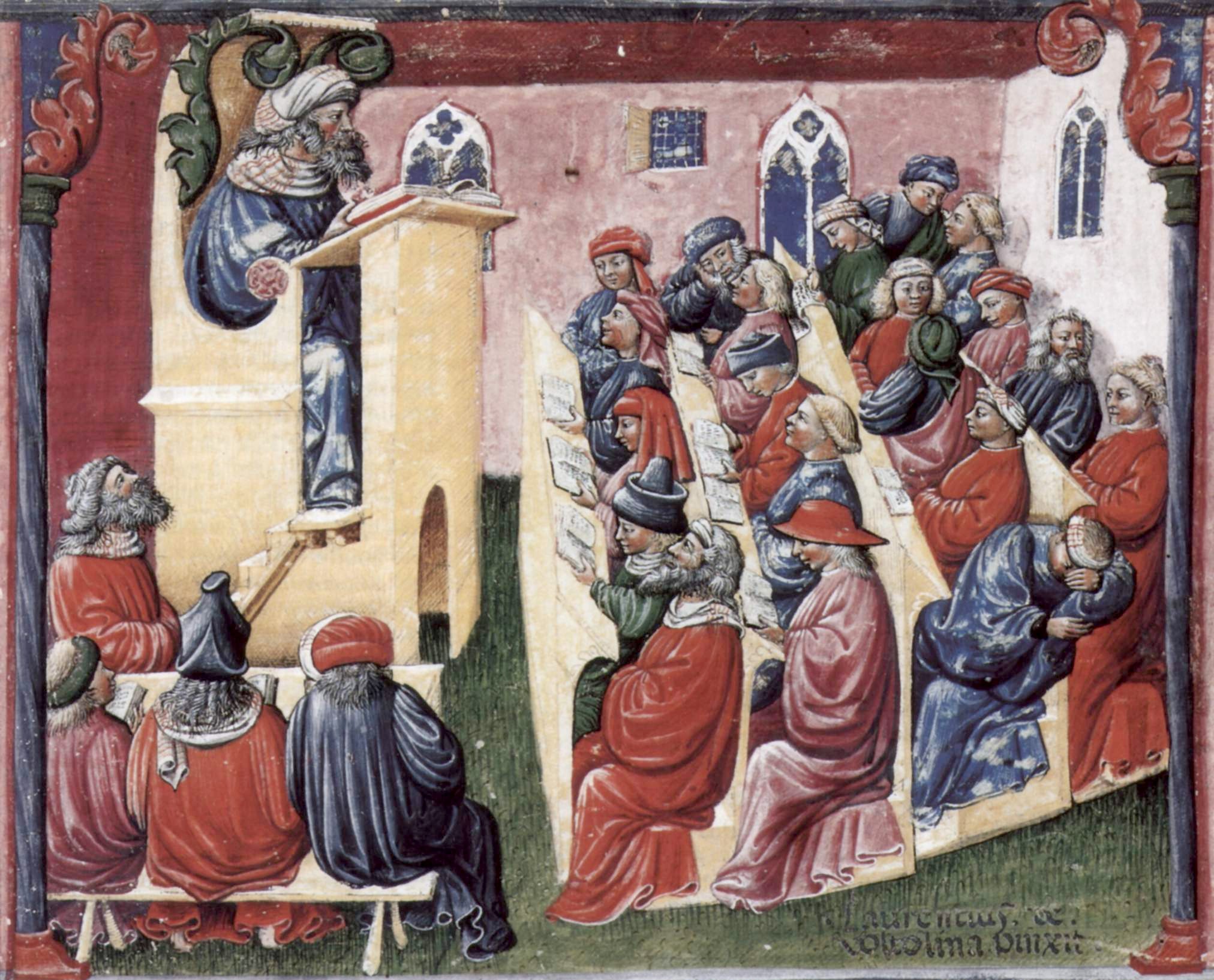
The classroom hasn’t changed much over the years. Over the centuries, actually.  In the 1350’s, artist Laurentius de Voltolina painted a scene of a university lecture in Bologna that looks quite like a present-day classroom: The professor sits at a podium at the front, pontificating to twenty-four seated students, one of whom is keeling over in apparent boredom, four of whom are ignoring the lecture while talking, and one of whom appears to be completely asleep. ( p 178-79)


Laurentius de Voltolina [Public domain], via Wikimedia Commons
What is it that prevents the true evolution of schools and education? Is it university entrance requirements? Is it fear? Does the education profession somehow naturally attract personalities who are rule bound and rigid in their thinking? I don’t think any one factor is entirely to blame, but "Digital School" in Clive Thompson’s book, Smarter Than You Think, propelled my thinking towards questions such as these.  Why do we seem to be so full of great ideas and progressive thinking, yet somehow we remain bound to a traditional curriculum built on traditional grades, percentages and standards. 


In Sugata Mitre’s Ted Talk, “Build a School in the Cloud”, he describes the institution of school as “obsolete” and “outdated”. In my work as a Special Education teacher in a distributed learning school, I have many students on my caseload who haven’t easily “fit” into the mainstream school environment. Central to Mitre’s talk and Thompson’s chapter titled, Digital School, is the idea that students, inspired by their own curiosity, will learn and explore very willingly. As I read and explored this theme, my thoughts kept returning to specific individual students that I work with. I have one student, burdened with a Generalized Anxiety Disorder, very likely meeting criteria as both Gifted and Learning Disabled, who is resistant to traditional curriculum and its mainstream delivery. Capable, but resistant, he’s not interested, doesn’t see the point and lacks motivation. However, he has been successfully coding computer programs for several years ; he has found his way to mentors, online, who share his passion and who guide him via online chat rooms when he has questions or is problem solving his way through significantly sophisticated levels of knowledge and skill on his learning path. I struggle to be the one to say, “Listen, that’s all awesome and great, but you really need to sink your teeth into this grade 9 Math or finish that project on the Renaissance.” We can, creatively, find some ways around some of his coursework, but I am not always successful in my advocacy for students in this context. This particular student has skills, abilities and strengths that are best accessed and utilized in the world of technology, following his own passions and interests. The relevance of the Renaissance or equivalent fractions to his world is a hard connection to make. The fact of the matter is, kids seek authenticity; the age old question “when am I ever going to use this?”comes up frequently and it can be challenging figuring out how to answer it. Maybe it’s not up to us, as educators, to provide the answer or rationale; maybe it’s the student’s own answer that matters most in this.


Consistent with the idea in this chapter that learning should be student centered, Sir Kenneth Robinson explains that “curiosity is the engine of achievement” in his Ted Talk, How to Escape Education’s Death Valley”. I believe that curiosity, or a high level of interest, is what has fueled my student in his pursuit of coding. Integral to this, however, is the fact that, as a subject area, coding is relevant for this student. Kids need to “buy in” to what they are learning; Thompson discusses the way blogs have been successfully used as a writing tool in classrooms and identifies an authentic audience or purpose of writing as integral to student motivation or “buy-in”. Authenticity and interest, or passion, are prerequisites, as far as I can see, to successful student-centered learning.


Thompson specifically discusses coding in this chapter and explains “programming has (deep) effects: For children, it becomes a philosophic act, a way of learning about learning.” (p. 188) It came to me as I read this that we keep trying to compartmentalize learning; the very way our curriculum is laid out, and the way many teachers are hired, is subject by subject, and this approach contradicts the idea that we want to maximize learner potential. Potential isn’t laid out subject by subject; one might be very Mathematical in his or her thinking, but as we know, Math can make its presence known in a wide variety of topics and concepts. And I have seen, firsthand, how many Math “thinkers” aren’t necessarily computation masters. Perhaps the evolution of education is


limited by the notion that we have subjects, rather than disciplines and, as Sir Kenneth Robinson pointed out in his exponentially viewed Ted Talk, “How Schools are Killing Creativity”, we value certain subject areas or skills over others. Perhaps we need to move towards seeing the child as a whole in the context of education, instead of continuing to try to break it down into parts, leading us away from authenticity.


I don’t know for certain what it is that inhibits the evolution of education to the degree that it can sometimes appear that we aren’t making any progress at all, but I think it’s very important that we continue pondering the question as we keep trying to move towards change. Clive Thompson’s chapter, Digital School, raised many points of interest and presented a variety of examples of people breaking the mold in their classrooms. There will be many deterrents, possibly naysayers, and we will make many mistakes, but Digital Schools inspired me to continue to strive towards change. It is messy, and often uncomfortable as we present ourselves in a vulnerable light in the context of our classrooms, to be able to confidently say, “I don’t know” and “let’s see what happens” to our students. Let’s keep painting a new picture of education, where it may be difficult to identify the “teacher” and where many students are talking, but where no one is fast asleep.

References

"Ken Robinson:  How to Escape Education's Death Valley." You Tube. Ted Talks, 10 May 2013. Web. 06 Dec. 2014.
"Sir Ken Robinson: Do Schools Kill Creativity?" You Tube. Ted Talks, 27 Feb. 2013. Web. 16 Dec. 2014.
"Sugata Mitra: Build a School in the Cloud." You Tube. Ted Talks, 27 Feb. 2013. Web. 16 Dec. 2014. 
Thompson, Clive. Smarter than You Think: How Technology Is Changing Our Minds for the Better. New york: Penguin, 2014. Print.


Saturday, 15 November 2014

Mismemories and Misremembering in the Digital Age

“Better late than never” is feeling more like a daily mantra for me this term than something uttered as I run doggedly into a coffee shop to meet a friend 15 minutes late, but here I am with my first #tiebc post… 2 book club meetings (I missed the 3rd) and 5 chapters in to Clive Thompson’s book, Smarter Than You Think.  Better. Late. Than. Never. Indeed.

Our #tiegrad book club meets every couple of weeks, and I must say how much I value these informal get-togethers, as much for the opportunity to discuss and share our thoughts on the readings as for the time to find the humour in our downtrodden moments, gain clarification or insight on some aspect of class, or discuss apparent obsessions with pirates and elephants.  My mood is always positive by the end of a #tiebc session and I am grateful.

In reflecting on my reading and our #tiebc discussions thus far, Chapter 2, “We, the Memorious“, particularly resonated with me. However, when we came together, our book club discussion didn’t lean into this chapter to any great extent. The chapter examines the way people use technology to record many, and in some cases, all aspects of their lives.  There were examples of people who chose to become virtual “lifeloggers”, recording all aspects of their lives in digital form, using digital logs to access details and memories that would otherwise be murky or altogether lost. I was intrigued as I read of MIT speech scientist, Deb Roy’s, “Total Recall” experiment where he and his wife wired their house to capture all aspects of their child’s first year.

One particularly interesting phenomenon revealed in the Roy experiment was the inaccuracies discovered in some of Roy’s own recollection of events;  when he looked at video footage of his son’s first steps, he discovered that “he’d completely mis-remembered the event” (p. 21).  While the “mis-remembered” aspects of the memory could be considered the less important details (time of day, sun shining, who was in the room), it is intriguing to me that our minds have the capability and inclination to fill in any memory gaps with creatively and logically constructed details, to make the memory complete.  I don’t see it as necessarily positive or negative, but it has me wondering why and at what point in time do these little shifts in the details of our memory occur? In Roy’s case, it didn't take much time at all to replace the actual details of the event with his mind’s own version of the details. 

This memory gap-filling phenomenon has me wondering which details of my own childhood or my children’s early years I have recreated or revised in one way or another. I met with my cousin yesterday and we briefly reminisced about a shared experience from our own childhood, and there were distinct differences in how we had “stored” the details of this specific event; certainly we were able to fill in some of each other’s gaps, but there were startling differences in what we remembered.  He remembers falling down a hill and hitting his head, of which I have no recollection, and I remember we wandered for what seemed like hours, lost in the woods.  The location, our ages, and circumstances all match, but key aspects of the memory have been remembered very differently.  I can see how the mis-remembered details of more serious events could be problematic. When I think about the fact that Roy’s mis-memory was skewed within a relatively short time, you can imagine the potential inaccuracies of recounted events from 10, 20, or 30 years ago.  

A potential solution for these memory gaps and mis-memories is the practice of “lifelogging”.  There are varying degrees of lifelogging.  At a basic level, for example, my father has, for years, habitually recorded the date, the weather, his physical activity (run: 52 mins. along the seawall with Bill), and any other random notables that seem worthy on a daily basis, without fail. The brevity and consistency of his record keeping make for a good reference point. When I ask, for example, what restaurant we ate at after that 10 km race 15 years ago, he can look through his “log” and tell me.  I can see the value of this habit, but, personally, I can also live quite well without it.  Taken to the other extreme, lifelogging with very intentional and constant recordings and / or photographs seems like an almost invasive and disruptive way to live one’s life. The idea of technology documenting all aspects of my life or my home in an ongoing, auto-set kind of way, is disturbing to me as well.  I get that there might be a time or circumstance where it’s really convenient to be able to look back at something, but I think I prefer to relying on my less than reliable grey matter.

In a sense, we are currently engaging in a form of lifelogging as we look at the prevalence of “selfies” and status updates.  Many, if not most, people are never without their smart phone or tablet, and we regularly engage in logging our lives this way.  It’s perhaps a step away from true lifelogging, but the outcome is much the same.  I think we have to consider how much time we, as a society, spend doing so and what we are missing as we are immersed in efforts to digitally record our lives. There have been many presentations, videos and talks to try to emphasize that we are missing much by trying to capture everything, and I am quick to agree. A great visual of this point is represented in the short video, I forgot my phone; while the video is, yes, dramatic, it presents familiar scenarios that many people can relate to.  
                                   

In considering both the ongoing, never-miss-a-second recording options for capturing “life” such as that used by Roy, and society’s current obsession with intentionally capturing meals, moments, and milestones via Instagram, Vine, Snapchat, and other means of social media, I can’t say that I see either as completely healthy or necessary. Like most things in life, there’s undeniable value to social media recordkeeping and documenting aspects of our lives digitally; I, for one, won’t be surprised if lifelogging as a practice becomes increasingly commonplace in the years to come.  However, there’s something very personal about our own, grey-matter-based, unrecorded memories and the fact that no one else can see them exactly as we do, in our own minds. Those mis-memories, with inaccuracies that are specific to the memory-holder, make for the best stories.


References

deGuzman, Charlene (Charstarlene). (2013, Aug 22). I Forgot My Phone (video file). Retrieved from  http://youtu.be/OINa46HeWg8
Thompson, C. (2013). Smarter than you think.  New York, New York: The Penguin Press