Showing posts with label #LearningProject. Show all posts

Monday, 6 April 2015

#tieyoga #LearningProject Summarized


         A vlog post to summarize my #tieyoga #LearningProject for #EDCI569. I had many insightful moments in my yoga practice these last few months and benefitted from increased flexibility that extended beyond my hamstrings and hips. The learning connections were, for me, overwhelming at times, as I realized the potential impact community can have on a learner.  

         On a positive note, I succeeded in uploading iMovie from my iPad to Youtube this time around. My first vlogging attempt saw me having to jump from iMovie over to Explain Everything due to (my own) learning obstacles. I'm proud of my willingness to tackle iMovie again and gave a little mental shout-out to myself after successfully uploading it to Youtube.  Sometimes we are so deeply immersed in a perceived challenge that we are unable to see the simple solution, as was the case for me with that first vlogging effort!

         I'm still working on saying less with more, so apologies for the length of the video. It's a skill that is far reaching for me and my progress is, apparently, slow, but I hope to get there sooner than later.  In the meantime, thanks for your patience and ongoing encouragement. 


Sunday, 5 April 2015

Measuring Up My #tieyoga Practice Sites

         I've attempted a "different" way of blogging this go around. Thanks to Christopher Lister for being the first in our #tiegrad cohort to post using Thinglink; overall I'm happy with my experience using this new-to-me tool. I worked very hard to try to find a way to embed my soundcloud audio clips so that if you clicked on one it would just play, rather than take you to the soundcloud site. Needless to say I was not successful with this. If this is indeed achievable, and someone does know how to make that work, I'd love to hear from you!

         Otherwise, these Piktochart visuals offer up a summary of my assessment of my various online yoga resources. Please don't feel the need to listen to every single link (unless you're considering taking up yoga online!), but pick and choose to get the gist of what I liked or didn't like about my online yoga sites.


Namaste

Sunday, 29 March 2015

The #tiefit perspective

         I've really enjoyed my participation in the #tiefit group this winter. As many of you are aware (because I say it every time I share on this topic), it's #notmylearningproject, but my activity in the group has enabled me to make so many valuable connections in my real #learningproject, #tieyoga.
         One of the things I really enjoyed about getting out and getting active as part of this group was just having the time outdoors; forcing myself out had such a positive impact on my energy and my emotional well being. I frequently paused on my walks to take pictures of the many views I enjoyed, along with the occasional selfie, knowing that building my image library would be considered resourceful by some (including this digital citizen right here).
         Today as I was looking through the photos, I wondered how I might use them, and decided to throw together a little video. I've used Youtube's video editor several times now, and I keep going back to it. After playing on Vimeo a bit, trying iMovie and having had experience with iMovie Trailer, I find myself defaulting to #videoeditor. I've also experimented with Explain Everything with success--and I can see that I have so much left to learn with Explain Everything, having barely scratched the surface. For today's purpose and my looming deadlines, however, Youtube's video editor is the answer. I appreciate its simplicity and accessibility. Some would argue it's too simple, with limited options around sound editing and image editing, but sometimes less is better. I already spend far too long on my blog posts and I could spend days editing photos and videos; the limitations, as it turns out, are a good thing.
         I realize the video falls to this side of corny, but the message is authentic--I appreciated stopping to smell the roses these last three months; I am the first to say I don't do it nearly enough. I could have also created a video to evidence the many impressive neighbourly connections I made on my walks--it seemed I regularly bumped into old friends, long lost soccer parents, and my kids' friends. Extending beyond the familiar faces, however, I became very cognizant of the benefit of just connecting with people--saying hello to fellow dog owners, commenting to a passerby about the beautiful day, or laughing about a seal popping up and back under the water. No matter what my emotional or physical state of affairs was when I stepped out the door, I never returned home cranky.
         Ultimately, #tiefit has energized me these last many weeks and made me easier to live with. I am looking forward to continued steps and benefits in the months to come. I hope you enjoy my little video.  Step on #tiefit peeps!

Wednesday, 18 March 2015

Expectation vs Reality or Product vs Process: My #tieyoga update


       A while back I made a Haiku Deck to document my #learningproject progress (or lack thereof) and changes to my plan in my #tieyoga practice.  Often in learning and teaching, we need to assess and reassess our progress  as we move through any given lesson, task, or project. I'm taking a bit of time today to reflect on this particular reassessment of my #tieyoga plan..
       The idea of dropping into a community or studio class once weekly is a great one. It allows me to access an environment that is more conducive to true yoga practice and mindfulness and provides access to the ever important yoga instructor, an expert, to monitor my postures and make corrections as necessary. This strategy has been difficult to implement due to the limitations of time in my life, largely due to my responsibilities as a mother, daughter, student, dog-owner, and full time teacher.
       Five at-home sessions each week is my ideal goal; it's a goal that will see observable results over a relatively short amount of time. Some weeks this has been achievable and other weeks it has not, for exactly the reasons noted above.

       I chose to focus on five key postures that directed my yoga attention to my "problem areas". Plagued by runner's hips and hamstrings (ie. tight), I included hip opening and hamstring stretching postures and feel that I've been successful in increasing my flexibility in these specific areas. I also wanted to target back bends because they are incorporated into many of the postures I am in awe of, such as standing bow and floor bow. Seeing a master yogi perform these postures is a beautiful thing and I wanted to feel the exhilaration of seeing the wall behind me during camel pose. In reality, however, I'm a little bit fearful. I would appreciate some help and guidance through the back bending postures and find them difficult to do at home on my own. Maybe I'm just not ready or maybe it's something that will be more achievable when I can actually practice 5 or more times per week. The other obstacle to my overall achievement of this goal has been the fact that I don't always know what is specifically covered in the yoga video I use (until I use it) and, while I have repeated my use of some videos, I have tried to really explore the different videos available to figure out what I like and don't like. This has been helpful in gaining insight to what's available, but it has slowed the general progress of my identified targeted areas.
       My expectation was to record my #tieyoga practice in my "Accountability Log". This is where expectation and reality actually met! I have been consistently committed to keeping a log of my practice, including time of day, video used, length of practice session, how I felt and goal(s) for next time.
       At times the fact that I have not been achieving my #tieyoga goals has caused me great stress, but I always go back to this script: My learning process is more important than my learning outcome. And, I have learned a lot. I've learned that life has limitations and distractions that are out of my control. I've learned that it's okay to change the game plan, adjust the route, or switch topics completely. I've learned what helps my practice and what doesn't. I've learned that I can do yoga at home, and I can do it enough that I actually notice the benefits. I've learned to have a sense of humour when the dog comes over and licks my face when I am in downward dog or when my kids are being so lovingly loud and fiercely physical with each other that I can't even hear the yogi's serene, rhythmic voice reminding me to breathe.  I've learned that I can reorganize my priorities to a great degree and that it's okay to sometimes just let things go--for awhile--even things I never thought I could, like social engagements and putting clean laundry away.  I've learned that logs and reflections do work and that my #tieyoga community is just me and, at the end of the day, that can be hard. Not impossible. But hard. 
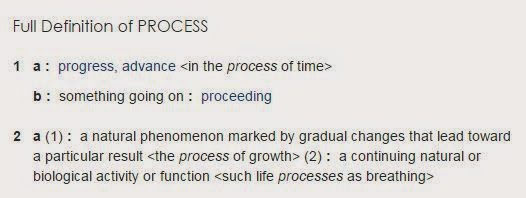
       So, what does this all mean? How can I transfer this learning and insight to my own practice as a teacher? How can I use this information to enable me to better support my learners?  I can follow my own advice: My learning process is more important than my learning outcome and ask students, "But what have you learned? How has this decision or that mistake enlightened you? Explain your thinking."
Merriam-Webster's definition of "process"
       The learning process is what shapes us as learners and what influences our decision-making and skill development as we participate in future learning tasks.  The end, of course, can matter greatly, and as many of us have seen firsthand both in our classrooms and in our #learningprojects, it may or may not be reached by all learners. However, my #tieyoga #learningproject has stressed the importance of the journey for me and that's what I hope I can take to my students; I want them to understand that growth is not only possible, but likely, as an outcome, regardless of reaching a destination. Get on board, keep trekking on your path (as twisted and switchback as it can sometimes seem) and make the most of your journey.

Monday, 16 March 2015

#tiefit & Personal

I took some time to reflect on my #tiefit journey and the #learningproject that is #notmylearningproject.  I used piktochart to create this infograph to act as an outline of sorts for my ramblings in my (very first) vlog post. I initially vlogged using iMovie, but had some difficulty uploading it from my iPad, and then, after a 2nd failed attempt at vlogging (more uploading issues) using my iPhone, I gave the app, Explain Everything, a try. My third time was lucky, indeed, and my novice attempt at vlogging is posted here for all to see.


I would have liked to have spent some time doing at least a bit of editing, but there are only so many hours in the day, so I'll save that for next time. As well, I think I need to work towards being "tighter" in my ramblings; you'd think that by the 3rd try things would have become pretty polished, but apparently not! At any rate, I am glad I tried vlogging and want to say that I'll do it again, but it certainly takes some effort to get past both listening to and looking at myself. One thing is for certain:  I could never have pursued an acting career.

Thursday, 26 February 2015

Stretching My Practice #tieyoga


Okay, it’s off to the races. I’m trying a new strategy tonight: blogging in 45 minutes or less. Since my last #tieyoga post and revised plan for regular practice via Haiku Deck, I have had more success with my #learningproject.  I've been more regularly practicing yoga and trying to focus on poses that will support the 5 key postures I identified as targets to improve on. 
Several key factors have contributed positively to my improved yoga practice over the course of this last week.  First and foremost, my Accountability Log, the log of accountability, my #tieyoga journal; it allows for a concrete view of my success (or shortcomings). I leave the Accountability Log  open on my computer (it’s just a basic word document) and as I log out of my yoga site, I open the document and plug in the date, the name of the video I used, running time, yogi’s name, and how it went.  Bam.  Done. And I know it’s there waiting for me on days I’m not so inclined to practice, which often (not always) kicks me in the general direction of the yoga mat.
 My motivation for practicing yoga at home has climbed to a more positive place; I think it’s because I am actually noticing some improvement in my flexibility…What? WHAAAT??? Yes, that’s right, increased flexibility.  That’s a good hook for me. I noticed a similar phenomenon with my #tiefit participation (the #notmylearningproject fitbit thing).  I am feeling so incredibly good with all my #tiefit walking, that I am currently getting out every day. I don’t want to miss a single day. I have set personal goals, such as nothing less than 10 km a day, 12 000 steps minimum as a daily total and walking to/from work at least twice a week.  While the #tiefit community drew me in, it’s now my own progress and improvement that is propelling me forward. Bingo.
Photo Credit: Bikram Yoga Westshore
Lastly, I follow my local yoga studio, Bikram YogaWestshore, on Twitter and Facebook and recently they shared these 3 photos to emphasize the progress we can make with regular practice over a fairly short amount of time.

Photo Credit: Bikram Yoga Westshore
 These photos inspired me to use some of the photos I started my project with, along with some I've taken more recently, in a different way.  I plan to create similar “collage” pics as a way to compare my own growth in my 5 targeted postures. It’s one thing to feel you've improved, but it’s quite another to see you've improved.  I’m excited to see what my #tieyoga growth looks like as I move through these weeks and weeks of practice. It is inspiring to me to see the personal improvements in these pictures over the course of one, two or three months!


It turns out that #tieyoga is alive and well when, a week ago, I thought it might have crashed and burned altogether. It’s challenging to have to figure out my own obstacles to learning and problem solve ways around them without other learners who are working on a similar thing. Many of our #tiegrad group are working on #learningprojects, but the projects are all so different.  Seeking out support from  my peers can be helpful when I am simply looking for a new strategy for my own project or trying to overcome a specific obstacle, but sometimes just to get going you need a buddy who is working on the same thing. Being part of a team is a huge part of our #tiefit success. Being a lone yogi at home has been my greatest #tieyoga challenge. 

In light of my recent shift, I’m now wondering if pursuing this #learningproject on my own is going to make success taste all the sweeter. We shall see….but for now, Namaste.

PS:  30 minutes for the writing. Pics & video took a little longer though.

Sunday, 22 February 2015

#tiegrad: A Community of Collaborators share out their favourite tech tools


Last #EDCI569 class we started a session of tech sharing between peers. I couldn’t help but think, “Wow, how awesome is this?!”  I was inspired by my peers who introduced me to more than a few tech tools I was unaware of and, in reflection, I was quick to think what a great and simple ProD this could be;  sign up to share out a tech tool and present in mini 15-20 minute workshops with staff throughout a school or within a family of schools. I’m thinking I might suggest this at my own school—as an alternative, it would be a great way to start each staff meeting—have a 10 minute Tool Share presentation by a staff member or members (voluntary of course).
During our bluejeans session, my peers shared tech tools such as the iPad app, Explain Everything, which is a tool that is used interactively with a whiteboard or as a means of screencasting. It seems to have an endless number of practical features including animation, drawing, laser pointer, narration, etc. This is the tool I am most excited to play with. Another tech tool shared was Padlet, a creation and curation tool that works kind of like an e-bulletinboard (I think). It can be launched via Google, which makes it easy for anyone with a Google account.  This tool was shared by @MelodyLWatson who uses it as a way to curate student work in the context of e-portfolios. Desmos was also shared during our session and the Math/Science cohort members were particularly enthusiastic about this tool, an online graphing calculator, that seems to bring a new dimension to comprehension of Math graphing concepts (which, sadly, are beyond my humanities minded brain).
In my position as Special Education teacher and Case Manager in a Distributed Learning school, I have some exposure to and knowledge of great tools, but coming up with ways to encourage learners to access and use them in this particular environment can be tough.  Much of my work is about supporting students to just get to school and to stay long enough to endure a conversation.  However, I have had some success using technology as a focal point for my students struggling with significant mental health issues.
One tech tool I've had a lot of success with is Haiku Deck.  While I haven’t used Haiku Deck to support presentation of curriculum content and academic learning directly, I have used it as a medium to reduce stress and take the focus off of the student when he or she is transitioning back into the school environment when significant anxiety has impeded his/her ability to attend.  In this instance, we often meet 1:1, have a low key chit chat (it’s mostly me who is chitting and chatting) and I try to get a sense of the student’s interests etc. I show them Haiku Deck on the iPad and create one, with the student’s input if s/he is willing; past examples include baking and snowboarding. It tends to be a fairly quick and easy process.  Afterwards I support the student to create one based on his/her own interest—the level of support varies somewhat, but generally I find even the most resistant students are willing.
Haiku Deck is available as an iPad app or in a web based format.  As well, it’s easy to send a completed Haiku Deck via email, or to share it via social media such as Facebook, Twitter, Pinterest and Google+.  Much like Twitter, Haiku Deck doesn’t have room to ramble on; its premise is one point, message or idea per slide.  Users are encouraged to be concise as too much text will reduce the impact of the image. By choosing just one word—e.g. snowboard—a myriad of pictures are immediately generated. Consequently, the user ends up with a selection of photos to further inspire the text content, which can be anything from one word to several sentences. Other ways to use this tool could include: 
  • KWL 
  • Brainstorming 
  • ESL
  • Poetry
  •  Summarizing
  • Reflections
  • Reading response
  •  Create an outline
  • Make connections between a Math concept to real life examples 
      Here is an example of the start of a KWL Haiku Deck:


Horses - Created with Haiku Deck, presentation software that inspires


I’ve included my own Haiku Deck example, which some of you may have seen previously, as it’s a reflection of my own #tieyoga #learningproject. 


#tieyoga - Created with Haiku Deck, presentation software that inspires


And, lastly, an example of a poem, a Haiku, in fact, written by yours truly, using Haiku Deck:
10 000 Steps - Created with Haiku Deck, presentation software that inspires


While the app has its own bank of shareable images, it also has the option to upload personal photos which is really useful if your learners have the option to take photos of their work or subject.  There is also a feature that enables you to control the slides from your smart device, which I have not tried, but would be handy if you were sharing in the context of a presentation. If anyone does have experience with that, I'd love to hear about it!

Sharing tech tools in the context of our own practice has been really helpful to me and made for the most meaningful learning around tech. Peer teaching in this way helps me to better pick and choose a tech tool in the most practical way and it's one more reason I value and appreciate my #tiegrad learning community so much. Thanks guys!

Saturday, 7 February 2015

3.5 Week Update: My #tieyoga Practice

In my last blog post I touched on the fact that my online yoga practice, while regular, was feeling unfocused. There are many different styles of yoga, many different postures, variations of the same posture between styles, and many different, often personal, approaches to teaching yoga. All of these things impact my own practice significantly. Personally, I would like to see my practice become less random in terms of my choice of "class"; I'd like my choice of yoga practice to move to a more intentional and thoughtful place. It was as I reflected on all of this that I realized I was lacking in adequate "prior knowledge"! My yoga experience, previously, has been limited to participation in Bikram Yoga, which is a fairly rigid sort of practice (details are below).  As a learner approaching her learning subject independently, I recognize that there are certain factors that will contribute to my success (or lack thereof), consistent with the Learner Control Principle discussed in Chapter 21 of Richard Mayer's (editor) book, The Cambridge Handbook of Multimedia Learning (2014).
Katharina Scheiter, author of the chapter, explains that learner control as a learning approach is more likely to be successful if "learners possess high levels of prior knowledge." (Scheiter, 2014, p. 487)

So, in the spirit of Learner Control Principle, I thought it would be a good idea to research and learn a little more about the different yoga styles.  With some help from Becky Ward's article called, "
14 Styles of yoga Explained Simply", I'm building my knowledge base to allow me to make better decisions and choices as a learner, thereby maximizing my success (ideally)! Yay me! What I've learned about different yoga styles follows here:

Ashtanga & Power Yoga—These are both high intensity yogas that incorporates cardio by flowing from one posture to the next. Ashtanga is more traditional and includes the same sequence of poses every class or session. Power Yoga, in contrast, varies the postures from class to class and does not include the more spiritual aspects of traditional yoga. These are similar to Flow, or Vinyasa Yoga, mentioned below.
Anusara—Similar to Iyengar but a lighter approach that is more personalized, not quite so serious. Students of Anusara yoga are encouraged to move through the poses in a more personal, expressive way. 


"Hot Yoga - Wikipedia Profile Picture"
by HealthZone - The Star. Licensed under
FAL via Wikimedia Commons - 
Bikram—This is the type of yoga that I have experience with already. It takes place in a hot room, where the temperature is maintained at somewhere around 100-105 degrees and humidity is just a way of life. Imagine doing yoga in a sauna for 90 minutes. There are 26 postures and each one is done twice; it’s the same sequence of postures and the instructor is required to follow the same guiding dialogue for each and every 90 minute class. Thus far, it’s still my favourite yoga option. I recognize aspects of Hatha and Yin yogas in the Bikram method, and it helps, somewhat, to explain my attraction to the Yin style.

Hatha—Hatha yoga, characterized by one pose followed by the next at a relaxed pace, is a basic style of yoga and great introduction to the practice. Hatha emphasizes mindfulness in its approach.

Iyengar—This is a traditional yoga that often utilizes props and instructors/yogis specializing in this style take bio-mechanics into strong consideration in guiding a student’s practice. There are brief pauses between postures. This type of yoga is recommended when recovering from an injury.
Jivamukti—This style of yoga includes lots of chanting in Sanskrit and incorporates a strong foundation based in very traditional and spiritual beliefs. 
Kripalu— The theme of Kripalu is three-fold based in developing awareness, acceptance and growth from your body’s own journey. It emphasizes reflection and awareness in your practice moving towards the holding of postures for extended periods of time. Meditation is also a feature of this style of yoga. 

Kundalini—This style of yoga keeps the body moving continuously with demanding poses. Kundalini is a term that translates to “serpent” and it’s meant to release this serpent-type of energy from your body. Think of those places in your back where you hold tension and stress; that would be the serpent energy. Kundalini yoga’s goal is to tap into that and get it moving so it can be released.
Kundalini Yoga Principle
Image from http://www.crystalinks.com/kundalini.html
Prenatal—Many women choose to practice yoga when they are pregnant; it’s a calm, gentle activity that can easily be adapted depending on the needs of the mom-to-be. This style of yoga can be practiced from the first days of pregnancy, right through postpartum/recovery stage. I used to work in a midwifery practice and the midwife often commented that women who were active in a strong yoga practice generally had an easier time moving through the stages of childbirth and recovery.

Restorative—Restorative yoga does just that—it restores body, mind and spirit. The blogpost where I found a lot of information on yoga styles described this yoga as “group nap time for grownups” (MindBodyGreen.com)! I like the sounds of that! It sounds kind of like Yin Yoga on steroids; you hold just 4-5 different poses for up to 20 minutes each. Restorative Yoga utilizes props and other modifications as needed.

Sivananda--The description of this style of yoga makes me believe it might be one of the more holistic approaches, incorporating "proper breathing, relaxation, diet, exercise, and positive thinking" (MindBodyGreen.com) with the goal of achieving a lifestyle that supports healthy living. It's a relaxed practice that follows the same 12 postures (asanas) each session.

Viniyoga--Similar to Anusara Yoga, Viniyoga is somewhat personalized, but I think the similarity ends there. Educators should be excited by this yoga style which emphasizes differentiation and adaptation based on the individuals needs and strenths. At the basis of this yoga style is a focus on contracting each muscle group prior to beginning the stretching of the posture. In other words, Viniyoga values a good warm up.


   Vinyasa-- Similar to Power Yoga, Vinyasa is derived from Ashtanga yoga and developed 
   out of the aerobics era of the 80's.  This yoga is sometimes called "Flow" and requires        more of a degree of stamina and fitness than something like Hatha yoga would.  It gets      your heart rate up and involves continuous flow, from one posture to the next.

   Yin Yoga—This yoga’s name has its origin in one side of the yin-yang concept and              focuses on long, deep stretches. The postures are held for approximately 5 minutes and      this style of practice is known to alleviate pain and stress. There is significant             emphasis on breath and breathing.

In moving forward, I'm going to consider what it was, specifically, that I liked or didn't like about an online yoga session. While I think it's important to try out different styles, I also think it's important to focus on the ones that are the best fit for me.  I admit to starting a video session and stopping it in the first five minutes more than once (okay, maybe more than 7 times). I recognize that I was jumping in to some videos without an understanding of what they were offering me.  As a #tieyoga student, it's important to know my own preferences and be able to make decisions based on the information available to me in the synopsis for each video. I believe I'll be able to make more informed choices after learning more about the various yoga styles. #tieyoga is definitely a work in progress!

References
Scheiter, Katharina.  (2014). Learner control principle in multimedia learning. In Richard E. Mayer (Ed.),  The cambridge handbook of multimedia learning (pp.487-512). Cambridge University Press. 

Sunday, 1 February 2015

Entering into week 3 with #tieyoga -- An Update


This week I thought I would try something different. This is a little out there for me--oh my goodness, listening to my own voice is not my idea of a good time--so thanks in advance for enduring!  I don't think I'll blog this way again, but it was good to try.  So, here I am, on Soundcloud, bringing you "Entering into week 3 with #tieyoga -- An Update."


And once you've had the pleasure of listening to my audio-blog...enjoy this fun Harold's Planet cartoon, Yoga For Wine Lovers!

Saturday, 24 January 2015

#tieyoga – Day 8

So, it’s been just over a week since I started working on my #LearningProject for EDCI 569, #tieyoga (yoga online) with the goal of practicing 5 times per week.  In terms of frequency, I’m pretty much there. My motivation is extremely low, however, and most days it’s like a cloud that hangs over my head and when I go to practice, it’s often done begrudgingly.
 
Problems:
Border Collie Lex loves yoga.
  • While I have set some goals (improving flexibility and practicing 5 times weekly), I believe my goals need word.  Aside from the frequency of practice, I don’t have any truly measurable outcomes.  As well, I haven’t made a commitment to my method of tracking and reporting on progress.  Basically, I’m lacking an assessment plan.
  • Practicing yoga in the middle of the day, in a busy household that has no available “yoga space” is not relaxing. The dogs, the kids bickering, my husband grinding coffee, someone playing loud music or loud…something…almost continuously throughout my 30 minute session somehow impacts the level of relaxation achieved and negatively impacts my motivation.
  • Finding the time, even though it isn't a huge time commitment, and ensuring that time slot coincides with those minutes in the day when I don’t feel exhausted…this is a challenge too, one which, again, impacts motivation.

Positives:
  •          Some days I practice yoga and I would have done nothing active otherwise
  •          I’m getting some coursework completed every time I practice
  •          I’m always glad I did it…okay, I never regret doing it.
  •          My physical flexibility is showing minor signs of improving

Strategies for improving the success of my online yoga practice:
1    1.  Make an assessment plan
a.       Tracking Progress
                                                               i.      Choose a pose from each target area (forward bends, back of the legs, hips, back bends, for example) and take before, during and after pics to track progress (improved flexibility)
                                                             ii.      Video footage of my practice
                                                            iii.      Each day reflect on the session (just jot down a couple of notes, how I felt, what I noticed, etc)
                                                           iv.      Blog a minimum of once weekly
b.      Record “practice” sessions using fitbit device
c.       Reflect, anecdotal ly,  on my “online learning”
                                                               i.      Using videos, pictures, reflections to record a brief comment following each practice session
      2. Try the other yoga site, Do Yoga With Me and continue to explore other sites through #yoga on Twitter.  Thus far, I've really only explored the paid site, My Yoga Online
      3. Force myself to stick to a scheduled time, when the house is quiet, or quieter; create a #tieyoga schedule, and FOLLOW IT.
      4.   Recruit a yoga buddy or buddies; my husband has said he will practice with me and I’m sure I could get one of my kids to join in an evening session. Misery loves company. Lol, kidding, I’m not miserable.
      5. Set up a #tieyoga space, even if it’s “portable” or temporary in nature, to ensure I have a location in the house that isn't high traffic and to allow my mind and body to make a mental association between the space and the activity.

This sounds like a solid plan, improved from my first blind leap into my #LearningProject on January 14th. Here are some pics, taken today (Jan 24th), of my postures in these early days of online #tieyoga practice.

Funny how when I'm in the posture, I think I've gone so much deeper than this. Must be the lighting.

Looking forward to more flexibility as it comes.

Watch for #tieyoga updates!