What-so-what-now-what...Indeed. After an especially productive pro-d session with my Principal, Sean McCartney, I reflected on the amazingly positive impact a collaborative partner can have on my own attempts to problem solve. Unfortunately, he's a busy guy and not always available. My program is a pilot: a multi age group of learners (7-13 years) in the annex of an elementary school, focusing on inquiry and hands-on learning opportunities in a highly personalized learning environment, sees me with a "schedule" that is different than that of the school we are situated at. As a result, we are almost always on our own; we have recess breaks on our own and lunch on our own and the peer group is very small. My school-based peer group is even smaller.
Following my pro-d morning where Sean and I tackled Learning Plans and reporting options, I am all the more aware of my lack of readily available collaborative opportunities. Unfortunately, I've got more than my fair share of new-program-problems to solve and am feeling a little desperate for collaboration opportunities. I've been sharing out through my #sparKtalK vlog posts trying to build a network with which to collaborate, but the momentum continues to be...non-existent. I am pushing through however, and am committed to my vlog through to the end of June with the hope that things pick up. As well, I will continue to pursue interactions with my PLN on Twitter and consult with professional and community contacts as that network continues to grow.
This week's "What"...Technology and limited resources. Have a watch (it's brief! honest!!) and please comment, questions, critique, chat, collaborate, or contribute in any way shape or form in the space below, via Twitter (@spedlearner) or via email: tross@sd61learn.
Showing posts with label #inquirylearning. Show all posts
Showing posts with label #inquirylearning. Show all posts
Saturday, 31 October 2015
#sparKtalK5 Solutions Sought

 I'm a lifelong learner working hard to be the best facilitator of learning I can be. Learner first--teacher second.
Mother to 4 strapping lads.
Happy to call myself Wife & Partner to my Mister.
Willing to hold up many.
Monday, 26 October 2015
#sparKtalK5 Vlog: The Big Reveal
Ah, delayed reflection reaps the
greatest reward, at least for me through this week's vlog post. I struggled with what
to do with my learners’ apparent lack of ability in the area of making
connections earlier this week. Of course, I was quick to interpret this as a
problem of theirs that I would need to support them with. However,
after taping my reflection, walking home from school, I considered this
whole connecting thing further. What did I do wrong? Why, after watching a video
they all seemed completely intrigued by, was it so difficult to draw out some connections?
What role did I play in this struggle?
Watch this week’s vlog post, beginning with my
embarrassingly early and quick resolve as I explain my “what”, followed by a later reflective post sharing my own more significant learning.
The big reveal. Here it is!
Thanks for watching! As usual, I’d love to hear back from
you! Questions, comments, criticisms, cheers,
or chit chat—all feedback is welcome and appreciated!
I'm a lifelong learner working hard to be the best facilitator of learning I can be. Learner first--teacher second.
Mother to 4 strapping lads.
Happy to call myself Wife & Partner to my Mister.
Willing to hold up many.
Sunday, 27 September 2015
#sparKtalK5 Tackling Overwhelm
An sparKtalK5 vlog post to share; I wish it was an update on Learning Plans, but alas, it is not. Just tackling my looming overwhelm this week. Really appreciate the support I've been getting both via this blog and via text/email from friends who are teachers. Please keep it coming as it really does help!
And, just to be clear, the tears were indeed my own and I did, in fact, recover before students arrived. Boo-hoo-ing at work is really not something that happens for me, so this was a big deal. Onward!
I'm a lifelong learner working hard to be the best facilitator of learning I can be. Learner first--teacher second.
Mother to 4 strapping lads.
Happy to call myself Wife & Partner to my Mister.
Willing to hold up many.
Monday, 21 September 2015
sparKtalK5
Incidental learning embraced me these last couple of weeks. At times, it's squeezed me so hard, it's taken my breath away. Or maybe that has just been my anxiety creeping in. This new venture has me overwhelmed.
First things first: my vlog has required a name change. I may have mentioned that certain tech doesn't like formatting the "<" symbol. I have learned that there are ways around this, but to keep it simple, I'm just going to re-brand. It's still early, right? So, out with the old ("talk<5") and in with the new... new name, new hashtag, but same location:
I hope my vlog posts will spark your interest, start conversation, and help me to build a community of connected learners. I'm jumping in the deep end this fall, definitely feeling in WAY over my head, as I try to navigate, support, and nurture a personalized learning environment with the learners in my (new-to-me) multi-age classroom. All ideas, suggestions, questions, comments, feedback, and recommendations are greatly appreciated.
I have so many questions and it's been challenging to even prioritize them--how to set up our space, how to connect learners in 5 different grades to the curriculum, how to assess and track learning, and how to use the GAFE tools available to me. Then there's FreshGrade and Khan Academy. Our days have been full of hands-on, interactive and collaborative learning activities as we try to establish ourselves as a community of learners, build trust, and get to know one another. However, I know we need to start dipping our toes in to the pool of inquiry and personalization. Where to even start??
Here is this weekend's post (video'd a week ago) outlining my "what-so what-now what" for the week.
First things first: my vlog has required a name change. I may have mentioned that certain tech doesn't like formatting the "<" symbol. I have learned that there are ways around this, but to keep it simple, I'm just going to re-brand. It's still early, right? So, out with the old ("talk<5") and in with the new... new name, new hashtag, but same location:
#sparKtalK5
I hope my vlog posts will spark your interest, start conversation, and help me to build a community of connected learners. I'm jumping in the deep end this fall, definitely feeling in WAY over my head, as I try to navigate, support, and nurture a personalized learning environment with the learners in my (new-to-me) multi-age classroom. All ideas, suggestions, questions, comments, feedback, and recommendations are greatly appreciated.
I have so many questions and it's been challenging to even prioritize them--how to set up our space, how to connect learners in 5 different grades to the curriculum, how to assess and track learning, and how to use the GAFE tools available to me. Then there's FreshGrade and Khan Academy. Our days have been full of hands-on, interactive and collaborative learning activities as we try to establish ourselves as a community of learners, build trust, and get to know one another. However, I know we need to start dipping our toes in to the pool of inquiry and personalization. Where to even start??
Here is this weekend's post (video'd a week ago) outlining my "what-so what-now what" for the week.
I'm a lifelong learner working hard to be the best facilitator of learning I can be. Learner first--teacher second.
Mother to 4 strapping lads.
Happy to call myself Wife & Partner to my Mister.
Willing to hold up many.
Monday, 6 April 2015
#tieyoga #LearningProject Summarized
A vlog post to summarize my #tieyoga #LearningProject for #EDCI569. I had many insightful moments in my yoga practice these last few months and benefitted from increased flexibility that extended beyond my hamstrings and hips. The learning connections were, for me, overwhelming at times, as I realized the potential impact community can have on a learner.
On a positive note, I succeeded in uploading iMovie from my iPad to Youtube this time around. My first vlogging attempt saw me having to jump from iMovie over to Explain Everything due to (my own) learning obstacles. I'm proud of my willingness to tackle iMovie again and gave a little mental shout-out to myself after successfully uploading it to Youtube. Sometimes we are so deeply immersed in a perceived challenge that we are unable to see the simple solution, as was the case for me with that first vlogging effort!
I'm still working on saying less with more, so apologies for the length of the video. It's a skill that is far reaching for me and my progress is, apparently, slow, but I hope to get there sooner than later. In the meantime, thanks for your patience and ongoing encouragement.
I'm a lifelong learner working hard to be the best facilitator of learning I can be. Learner first--teacher second.
Mother to 4 strapping lads.
Happy to call myself Wife & Partner to my Mister.
Willing to hold up many.
Friday, 3 April 2015
Rediscovering Grace Under Pressure, with thanks to Dave Cormier
What? No curriculum? When Dave Cormier explained to our #tiegrad
cohort that he teaches his university course(s) without a true curriculum my
initial reaction was, “You can do that?!” In the days that followed the Cormier
Session, I kept revisiting this detail. How does it
work? How could it work? How would students react? What would their
parents say? How would my peers respond? ¡Ay! Caramba!
This particular blog post has been overwhelming for me to
tackle, as there have been so many aspects and significant moments of the
Cormier Session that resonated with me. I've actually had to force myself to keep coming back to this post, as
the overwhelm gradually began to evolve into avoidance. There were big ideas
shared in this session, and by big, I’m talking transformative big,
mover-shaker big, B-I-G Big. Finally,
after an encouraging post by Melody Watson and brief exchanges with Trevor MacKenzie,
I decided my strategy would be to hang on to just one of Dave’s many inspiring
comments, process it, reflect on it, and elaborate on my very many mullings and
musings.
 Since our session, my thoughts have turned to the many times
over the years that, as a parent, I would exclaim to my husband, “Don’t these
teachers ever TALK to each other?!!”, as I watched one of our four kids crumple
under the stress of multiple project and papers all with (fairly inflexible)
due dates. To make matters all the more
frustrating, these projects and papers usually had widespread potential for
overlap. From the teacher perspective, I
wonder why we are so reluctant, as a collective group, to encourage students to
reuse, resubmit, or “double-dip” their efforts for different courses. As an example, in his grade 11 year my own
son had to write several Social Studies papers,
create a major project for his Integrated Studies course, and write multiple
English essays. This would seem a
fantastic opportunity for the 3 teachers at the helm to work together, offer up
one (or several) shared project(s) for the learners that could support meeting learning
outcomes in all three courses. Why don’t we model working smarter, not harder
and support, heck, require kids to do
the same?
As kids move through the different levels of school—elementary,
middle/junior, and secondary—the lines between subject areas become more fast
and firm; the opportunities to develop
their creative talents and their problem solving and communication skills
become more prescribed (possibly even less valued if we consider shifts
away from “play” and “making”). There
can be a lot of hoop jumping for kids in the middle and secondary years and
they know this. What is the value of curriculum if we can’t deliver it without
redundancy? Recently, for example, I
have been witness to a Gifted learner (not that that should even matter), basically
avoiding or, perhaps refusing, to submit his Math homework packages, yet completing
each unit test with sound results (90-95%-ish). Typically he would complete the
homework packages just enough to “get it” and then cease working on them. His teacher demanded that he go back and complete
all of the packages, work that counts for “completion” marks only. Why? The response: “I can’t give him special treatment.” This mentality has to change. Each learner is
an individual, with distinct needs and strengths, unique circumstances, and a
very personal learning profile.
We shouldn't be treating all students in any given class the same. Dave Cormier said, “What you can assess is how hard they are working and how far they have come.” A highly capable student, such as the gifted learner in the example above, would be considered to have made minimal effort and, quite possibly, demonstrated minimal growth, even though he has mastered the concepts and skills. Another student in the same class, for whom Math is very challenging, may have demonstrated significant learning and effort. Wouldn't it be awesome to offer all learners the opportunity to access learning at their instructional level so working hard was an authentic process and subsequent growth was inevitable?
I often tell my own children the rules in our family are potentially
different for each of them. For example, a curfew of 11 pm may be needed for the one
who never texts to tell us where he is or frequently misses the last bus
home, while another may not need a curfew at all as a result of his “by the
book” approach to most aspects of his life. The
idea of integrating coursework and even subject areas in middle and high school
is, of course, daunting to many educators who have never done it this way. Cormier
encourages us to create opportunities for students to be creative, learners who
can deal with an uncertain world and a capricious life. Why would we ask them
to show us (in a homework package, for example) what they've already
demonstrated (in a unit test)?
In her
blog post on the Cormier Session, Melody Watson says, “Life is messy and full
of uncertainty. Learning needs to be messy too…I think we need to get more
comfortable with letting kids struggle.”
I would take this a step further to say that, as educators, we need to
be personally modelling this willingness to get our hands dirty, make mistakes,
and struggle to our learners. GeorgeCouros, in his recent blog post, 3 Important Shifts in Education, says: “Listening
to students is not enough; we must bring them into the change process”. Along
these lines, Dave Cormier, shared his curriculum-free syllabus with us; in
looking at this document, I am reminded of the importance and value in inviting
encouraging, or requiring students to participate in their learning plan, to
support their excitement, curiosity, interest and desire to learn. In thinking about a curriculum free approach, I have to tell myself, “You don’t need to throw out the entire
curriculum today, but find a spot where you can break down the walls a little
bit,” which helps the subtle anxiety to dissipate.

In my years as a rower, one of my coaches relied on idiomatic language and cliches to carry many of his inspirational pre-race chats with our crew. He regularly referred to the dangers of “reckless
abandon”—so much energy spent and so little to show for it—and emphasized the importance
of being able to go all out with control; he used the term, “grace under
pressure”. In my #tieyoga videos, one
yogi refers to this same idea as “joyful discomfort”.
I often think of these phrases in the context of education and shifting teaching
practices. We need to be able to support learners to be able to
experience the messiness of learning, the pressure or discomfort of it, with support garnered from elements of structure and guidance, ultimately yielding the "grace" or joy we want for all learners, ourselves included. Similar to my rowing experiences, part of mastering “grace under pressure” requires occasionally
embracing “reckless abandon”. To be able to push ourselves and our
boundaries as learners (teacher-learner or student-learner), we need to know
where the edge is and occasionally fall off of it. If we want learners to find
their “flow”, the sweet spot or spark, they need to know where their near
misses take them. Confidence in our abilities is gained through these experiences and in knowing there are some parameters that will help us make our way back on course.
My Cormier Session take-away is something that I actually already knew, but didn't fully recognize as relevant to education. Dave reminded
me to be brave and bold, the importance of letting go. I learned as an elite athlete that If I'm not able to let go, I won't ever reach my maximum potential; further, as we grow, our maximum potential continues to change and expand. Our #tiegrad session with Dave made me realize that "grace under pressure" holds true, regardless of the context. Even if it’s what feels like the smallest change to my
practice, I need to keep pushing. A
prescribed curriculum leaves little room for getting messy, be it gracefully or
recklessly. Ticking the boxes and jumping through hoops seems to be producing learners (and, perhaps, teachers) who are
uncomfortable taking risks and who just want to be told what to do, if they
haven’t already checked out altogether. The Cormier Session helped me to extend an aspect of my own value system to my approach to learning and teaching; I want to walk the talk, toe the line, and approach each day as
an educator seeking joyful discomfort and exuding grace under pressure. I hope, through sharing my process and allowing peers and learners to observe me in the occasional state of reckless abandon, I can inspire others to do the same.
I'm a lifelong learner working hard to be the best facilitator of learning I can be. Learner first--teacher second.
Mother to 4 strapping lads.
Happy to call myself Wife & Partner to my Mister.
Willing to hold up many.
Wednesday, 18 March 2015
Expectation vs Reality or Product vs Process: My #tieyoga update
A while back I made a Haiku Deck to document my #learningproject progress (or lack thereof) and
changes to my plan in my #tieyoga practice. Often in learning and teaching, we need to assess and
reassess our progress as we move through
any given lesson, task, or project. I'm taking a bit of time today to reflect on
this particular reassessment of my #tieyoga plan..




 I chose to focus on five key postures that directed my yoga attention to my "problem areas". Plagued by runner's hips and hamstrings (ie. tight), I included hip opening and hamstring stretching postures and feel that I've been successful in increasing my flexibility in these specific areas. I also wanted to target back bends because they are incorporated into many of the postures I am in awe of, such as standing bow and floor bow. Seeing a master yogi perform these postures is a beautiful thing and I wanted to feel the exhilaration of seeing the wall behind me during camel pose. In reality, however, I'm a little bit fearful. I would appreciate some help and guidance through the back bending postures and find them difficult to do at home on my own. Maybe I'm just not ready or maybe it's something that will be more achievable when I can actually practice 5 or more times per week. The other obstacle to my overall achievement of this goal has been the fact that I don't always know what is specifically covered in the yoga video I use (until I use it) and, while I have repeated my use of some videos, I have tried to really explore the different videos available to figure out what I like and don't like. This has been helpful in gaining insight to what's available, but it has slowed the general progress of my identified targeted areas.
 My expectation was to record my #tieyoga practice in my "Accountability Log". This is where expectation and reality actually met! I have been consistently committed to keeping a log of my practice, including time of day, video used, length of practice session, how I felt and goal(s) for next time.
At times the fact that I have not been achieving my #tieyoga goals has caused me great stress, but I always go back to this script: My learning process is more important than my learning outcome. And, I have learned a lot. I've learned that life has limitations and distractions that are out of my control. I've learned that it's okay to change the game plan, adjust the route, or switch topics completely. I've learned what helps my practice and what doesn't. I've learned that I can do yoga at home, and I can do it enough that I actually notice the benefits. I've learned to have a sense of humour when the dog comes over and licks my face when I am in downward dog or when my kids are being so lovingly loud and fiercely physical with each other that I can't even hear the yogi's serene, rhythmic voice reminding me to breathe. I've learned that I can reorganize my priorities to a great degree and that it's okay to sometimes just let things go--for awhile--even things I never thought I could, like social engagements and putting clean laundry away. I've learned that logs and reflections do work and that my #tieyoga community is just me and, at the end of the day, that can be hard. Not impossible. But hard.
So, what does this all mean? How can I transfer this learning and insight to my own practice as a teacher? How can I use this information to enable me to better support my learners? I can follow my own advice: My learning process is more important than my learning outcome and ask students, "But what have you learned? How has this decision or that mistake enlightened you? Explain your thinking."
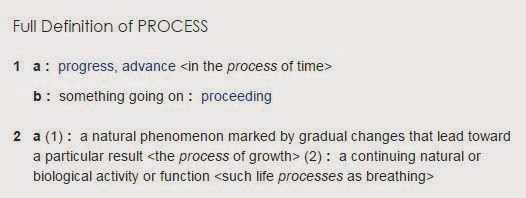 |
| Merriam-Webster's definition of "process" |
I'm a lifelong learner working hard to be the best facilitator of learning I can be. Learner first--teacher second.
Mother to 4 strapping lads.
Happy to call myself Wife & Partner to my Mister.
Willing to hold up many.
Sunday, 1 March 2015
#makered: A Try Different, Not Harder Approach
A week ago we were honoured to have Sylvia Martinez join our
#tiegrad session as a guest speaker. Sylvia has been integral to the Maker
Movement in education and co-authored the book, Invent to Learn, with GaryStager. Within the first ten minutes of
our session, I had the book slotted into my “must reads” list!
As I listened, I could see how the maker movement (#makered)
represents everything that is the BC Ed Plan including the way it supports the development of skills such as collaboration,
problem solving, creativity, communication, and critical thinking. Whether it’s having a weekly scheduled Genius
Hour, a physical classroom/school based space dedicated to “making” or creating, or a bin of interesting materials readily available and regularly filled
for our learners to explore-invent-create according to their imagination and
creative thinking, making is a key component of learning. It’s about encouraging learners to think of
themselves as contributors, inventors, creators, and artists.
Jay Silver talks about the fact that “sometimes what we know gets in the way of what could be” in his Ted Talk, Hack a Banana, Make a Keyboard. This statement hung out in my thoughts for some
time, and has
really impacted me. I connect with Mr. Silver’s idea in the context of my own
readings for my lit review that looks at obstacles that prevent educators from seizing opportunities that would enable a shift in their own pedagogical
practice. Silver goes on to question how we, as adults and young people in this world, can become “agents
of change” who see “the world as malleable”? I feel that it’s time to realize
that our education system needs to go “live” and recognize the need for our approach to teaching and learning to
become more dynamic, to better reflect the ever changing world we live in and the needs of our young people, before the institution of "school" and the service we provide as educators become systemically
archaic.
While I listened with interest to the discussion that took
place between Sylvia and our #tiegrad cohort that Thursday night, I kept
wondering how “making” could be a more significant component in what I do as a
special ed teacher. I know I can always support my colleagues in (and out of) their classrooms,
make myself available in more collaborative ways or to lead something on another teacher’s behalf
and that is, essentially, my goal from day to day, but there is much of my job that feels
prescribed and dependent upon working with peers who may, or may not, buy in, and our perceptions of student needs do not always line up--often they do, but sometimes they don't. Along with relying on other people’s schedules and agendas, and the endless amounts of paperwork and meetings that I am required to complete or attend, I find myself swimming against the current to try to reach the goal of meaningful support. I find myself wanting to know what other
Special Education teachers and Case Managers, at the various levels of
education are doing, if anything, to provide #makered support and/or creative opportunities, as well as to demonstrate their value. Is there a place for me in the #makered movement?
Being a Special Education Teacher is definitely a
multi-faceted role, and realistically it requires me to wear many hats, some of them more happily than others. I so greatly appreciated the inspiration behind Sylvia’s rhetorical question,”Why is
school so hell bent with weeding kids out who aren’t so good with Math or
paper/pencil (tasks)?” #tiegrad cohort member, Jake Main, echoed this when me wrote, "Why should kids need to conform to school? Why can't school conform to kids?" in our chat window during the session. These thoughts epitomize the students I work with and the ones who can readily benefit from all of us to continue trying different, as opposed to trying harder. What would happen if I bought a $50 Makey Makey Kit and pulled
that in to my support role? Perhaps if I start with a specific type of learner
and/or a peer who would dive in…I'll let you know. In the meantime, I would love to hear how other Special Ed teams are creatively utilizing their SpEd Teachers in the context of creativity and inquiry.
I'm a lifelong learner working hard to be the best facilitator of learning I can be. Learner first--teacher second.
Mother to 4 strapping lads.
Happy to call myself Wife & Partner to my Mister.
Willing to hold up many.
Sunday, 15 February 2015

The Long Overdue Research Update
For whatever reason, overwhelm, lack of confidence,
indecision, or, perhaps, sheer avoidance, I have been lacking in my research
update posts. It isn't for lack of reading and thinking; goodness knows I've been doing a lot
of that. So, here goes...the much anticipated update.
The positives:
- My #tiegrad reading group is an absolute god-send. While resources have been shared, I find that the greatest value gained from participation in the reading group is moral support. We seem to take turns encouraging and supporting each other from week to week, through periods of dead-ends or overwhelm, confusion about reference tools and theories, and balancing life between family, work, fitbits, research and blogposts. I am immeasurably grateful for my fellow #monkeyminds in #tieinquiry.
- Finding appropriate research articles hasn’t been the problem I thought it might be. I’ve been using search terms such as
- educational reform
- inquiry learning
- personalized learning
- shifting teacher practice personalized
- shifting teacher practice
- shifting teacher practice inquiry
- pedagogical reform
- obstacles reform practice teacher
- factors reform practice teacher
- teacher professional development inquiry
- shifting practice inquiry support(s)
The challenges:
- While finding articles hasn't been a problem, finding the time to meaningfully scan, read and absorb their content has been more difficult.
- Determining my curation method and organization of information has been daunting. I still have not confirmed my referencing tool.
- Figuring out the best way to incorporate or refer back to my theoretical frameworks is on the back burner. I'm hoping it will become more apparent as I work through my articles. Originally I was considering constructivism and social theory as my two main theories, but now I'm leaning more towards constructivism and connectivism as mypoints of reference.
I’m hopeful that, as I continue to read through the many
articles, the themes that surface will help to guide me towards a logical
outcome.
 I'm a lifelong learner working hard to be the best facilitator of learning I can be. Learner first--teacher second.
Mother to 4 strapping lads.
Happy to call myself Wife & Partner to my Mister.
Willing to hold up many.
Saturday, 7 February 2015
3.5 Week Update: My #tieyoga Practice
In my last blog post I touched on the fact that my online yoga practice, while regular, was feeling unfocused. There are many different styles of yoga, many different postures, variations of the same posture between styles, and many different, often personal, approaches to teaching yoga. All of these things impact my own practice significantly. Personally, I would like to see my practice become less random in terms of my choice of "class"; I'd like my choice of yoga practice to move to a more intentional and thoughtful place. It was as I reflected on all of this that I realized I was lacking in adequate "prior knowledge"! My yoga experience, previously, has been limited to participation in Bikram Yoga, which is a fairly rigid sort of practice (details are below). As a learner approaching her learning subject independently, I recognize that there are certain factors that will contribute to my success (or lack thereof), consistent with the Learner Control Principle discussed in Chapter 21 of Richard Mayer's (editor) book, The Cambridge Handbook of Multimedia Learning (2014).
So, in the spirit of Learner Control Principle, I thought it would be a good idea to research and learn a little more about the different yoga styles. With some help from Becky Ward's article called, "14 Styles of yoga Explained Simply", I'm building my knowledge base to allow me to make better decisions and choices as a learner, thereby maximizing my success (ideally)! Yay me! What I've learned about different yoga styles follows here:
Ashtanga & Power Yoga—These are both high intensity yogas that incorporates cardio by flowing from one posture to the next. Ashtanga is more traditional and includes the same sequence of poses every class or session. Power Yoga, in contrast, varies the postures from class to class and does not include the more spiritual aspects of traditional yoga. These are similar to Flow, or Vinyasa Yoga, mentioned below.Anusara—Similar to Iyengar but a lighter approach that is more personalized, not quite so serious. Students of Anusara yoga are encouraged to move through the poses in a more personal, expressive way.
 |
| "Hot Yoga - Wikipedia Profile Picture" by HealthZone - The Star. Licensed under FAL via Wikimedia Commons - |

Bikram—This is the type of yoga that I have experience with already. It takes place in a hot room, where the temperature is maintained at somewhere around 100-105 degrees and humidity is just a way of life. Imagine doing yoga in a sauna for 90 minutes. There are 26 postures and each one is done twice; it’s the same sequence of postures and the instructor is required to follow the same guiding dialogue for each and every 90 minute class. Thus far, it’s still my favourite yoga option. I recognize aspects of Hatha and Yin yogas in the Bikram method, and it helps, somewhat, to explain my attraction to the Yin style.
Hatha—Hatha yoga, characterized by one pose followed by the next at a relaxed pace, is a basic style of yoga and great introduction to the practice. Hatha emphasizes mindfulness in its approach.
Iyengar—This is a traditional yoga that often utilizes props and instructors/yogis specializing in this style take bio-mechanics into strong consideration in guiding a student’s practice. There are brief pauses between postures. This type of yoga is recommended when recovering from an injury.
Jivamukti—This style of yoga includes lots of chanting in Sanskrit and incorporates a strong foundation based in very traditional and spiritual beliefs.
Kripalu— The theme of Kripalu is three-fold based in developing awareness, acceptance and growth from your body’s own journey. It emphasizes reflection and awareness in your practice moving towards the holding of postures for extended periods of time. Meditation is also a feature of this style of yoga.
Kundalini—This style of yoga keeps the body moving continuously with demanding poses. Kundalini is a term that translates to “serpent” and it’s meant to release this serpent-type of energy from your body. Think of those places in your back where you hold tension and stress; that would be the serpent energy. Kundalini yoga’s goal is to tap into that and get it moving so it can be released.
Kundalini—This style of yoga keeps the body moving continuously with demanding poses. Kundalini is a term that translates to “serpent” and it’s meant to release this serpent-type of energy from your body. Think of those places in your back where you hold tension and stress; that would be the serpent energy. Kundalini yoga’s goal is to tap into that and get it moving so it can be released.
 |
| Kundalini Yoga Principle Image from http://www.crystalinks.com/kundalini.html |
Prenatal—Many women choose to practice yoga when they are pregnant; it’s a calm, gentle activity that can easily be adapted depending on the needs of the mom-to-be. This style of yoga can be practiced from the first days of pregnancy, right through postpartum/recovery stage. I used to work in a midwifery practice and the midwife often commented that women who were active in a strong yoga practice generally had an easier time moving through the stages of childbirth and recovery.
Restorative—Restorative yoga does just that—it restores body, mind and spirit. The blogpost where I found a lot of information on yoga styles described this yoga as “group nap time for grownups” (MindBodyGreen.com)! I like the sounds of that! It sounds kind of like Yin Yoga on steroids; you hold just 4-5 different poses for up to 20 minutes each. Restorative Yoga utilizes props and other modifications as needed.
Sivananda--The description of this style of yoga makes me believe it might be one of the more holistic approaches, incorporating "proper breathing, relaxation, diet, exercise, and positive thinking" (MindBodyGreen.com) with the goal of achieving a lifestyle that supports healthy living. It's a relaxed practice that follows the same 12 postures (asanas) each session.
Viniyoga--Similar to Anusara Yoga, Viniyoga is somewhat personalized, but I think the similarity ends there. Educators should be excited by this yoga style which emphasizes differentiation and adaptation based on the individuals needs and strenths. At the basis of this yoga style is a focus on contracting each muscle group prior to beginning the stretching of the posture. In other words, Viniyoga values a good warm up.
Vinyasa-- Similar to Power Yoga, Vinyasa is derived from Ashtanga yoga and developed
out of the aerobics era of the 80's. This yoga is sometimes called "Flow" and requires more of a degree of stamina and fitness than something like Hatha yoga would. It gets your heart rate up and involves continuous flow, from one posture to the next.
In moving forward, I'm going to consider what it was, specifically, that I liked or didn't like about an online yoga session. While I think it's important to try out different styles, I also think it's important to focus on the ones that are the best fit for me. I admit to starting a video session and stopping it in the first five minutes more than once (okay, maybe more than 7 times). I recognize that I was jumping in to some videos without an understanding of what they were offering me. As a #tieyoga student, it's important to know my own preferences and be able to make decisions based on the information available to me in the synopsis for each video. I believe I'll be able to make more informed choices after learning more about the various yoga styles. #tieyoga is definitely a work in progress!
References
Scheiter, Katharina. (2014). Learner control principle in multimedia learning. In Richard E. Mayer (Ed.), The cambridge handbook of multimedia learning (pp.487-512). Cambridge University Press.
I'm a lifelong learner working hard to be the best facilitator of learning I can be. Learner first--teacher second.
Mother to 4 strapping lads.
Happy to call myself Wife & Partner to my Mister.
Willing to hold up many.
Tuesday, 27 January 2015
The Trials and Tribulations of Finding a Research Topic Focus
Narrowing down my focus on a single topic for my MEd research has been a
STRUGGLE (yes I am yelling, virtually). As
a Special Education teacher in a Distributed Learning (DL) school, I wonder if
it would have seemed easier to latch on to something if I worked in a more
typical school environment. My areas of interest vary widely and, while I know
I could have set myself up quite easily to have access to a classroom in a
different school, I kept coming back to the fact that I’d prefer that my
research topic be relevant to my own work environment.
Over the last 3 years, I have seen a significant rise in students moving
to our DL school as a response to personal challenges and obstacles to learning
that they have not been able to overcome in their mainstream neighbourhood schools. Many of the students who end up on my
caseload are working hard to overcome anxiety and other mental health
challenges while attempting to tackle grade level curriculum. I find that the students on my case load require
great flexibility in their learning plans and they benefit from a personalized
approach. My first glance at BC's Ed Plan, specifically its description of
“Personalized Learning for Every Student,” hooked me. The explanation that educators will have “the
flexibility to make sure each student is well served by their educational
program,” the description of each learner as “unique”, and the commitment of
our education system to “support each student’s interests and ways of learning”
made me excited to be a teacher. The list of the 4 Action Steps that
followed the explanation further inspired me; the talk of competencies, fewer
but higher level outcomes and increased flexibility sealed the deal. While the document's proposed plan felt like a good fit for me upon first viewing, with its potential benefits for learners and flexibility with curriculum,
others in our profession have been slower to warm up. I have
observed a good number of educators taking advantage of the opportunity, and encouragement, really, to shift
their practice in the direction of personalized learning, while others prefer
to stick with what they know and, in the context of their own classrooms, what
they believe works. Risk taking is uncomfortable for many learners, the
students I work with in particular, and I see a parallel that exists between my
own peer group and the students we teach; just as we scaffold learning for our
students, meet them where they are, I wonder if there are any specific supports
or strategies that might better support shifts in practice among educators, as learners, navigating their way to a new approach.
My identified research topic is based in the adoption of personalized
learning approaches in middle school. Curriculum/pedagogical change is needed
to move ahead with personalized learning. I am choosing to focus on middle
school, as it seems to be a time when many students derail from the
mainstream approach, some students’ families look for alternatives and while
others simply stop attending. My identified Research Problem is to explore factors
that prevent and/or support a pedagogical shift in practice even though recent
curriculum documents encourage the move towards personalized learning as an
instructional approach.
My Research Questions:
- If teachers and students had something to help map out their project, term or semester to support personalized learning, would that help them adopt that approach?
- Would a “planner”, guide, or other structured template, that somehow linked to the learning outcomes, assist teachers and students in the successful adoption of personalized learning?
- How can we ensure there is visibility of learning and learning outcomes?
- Does learning transparency of the teacher, in the context of personalized learning, impact students? For example, does a teacher sharing out his/her own learning goals, risk-taking and reflections (as relevant) impact student learning?
My questions are too many--I realize that--but I hope through readings
and research I will be able to narrow my focus and peel back some of the layers
to address a specific question.
On a positive note, I recently discovered the hashtag, #plchat, on Twitter, and I’ve taken to meandering
through past links and posts put out by its users. I’m enjoying some good reads
on @pernilleripp ‘s blog, Blogging Through the Fourth Dimension, with posts such as this one, titled,
“9 Barriers to Personalized learning and How We May Work Around Them”. My time right now is mostly focused on trying to hone the craft of “searching” and fine tuning my key terms, as well as choosing my preferred methods and structures for curating and referencing resources I find. I am in a continued state of overwhelm, but I have my first two journal articles started. The ball is, officially, rolling.
So here I am, ready to conclude this blogpost
update on my research progress and, believe it or not, I still have doubts about my topic. I will
soldier on, however, continue with my reading, perusing and blogging, and hope
with all my might that I settle into my groove and find my flow really, really soon.
I'm a lifelong learner working hard to be the best facilitator of learning I can be. Learner first--teacher second.
Mother to 4 strapping lads.
Happy to call myself Wife & Partner to my Mister.
Willing to hold up many.
Subscribe to:
Posts (Atom)